
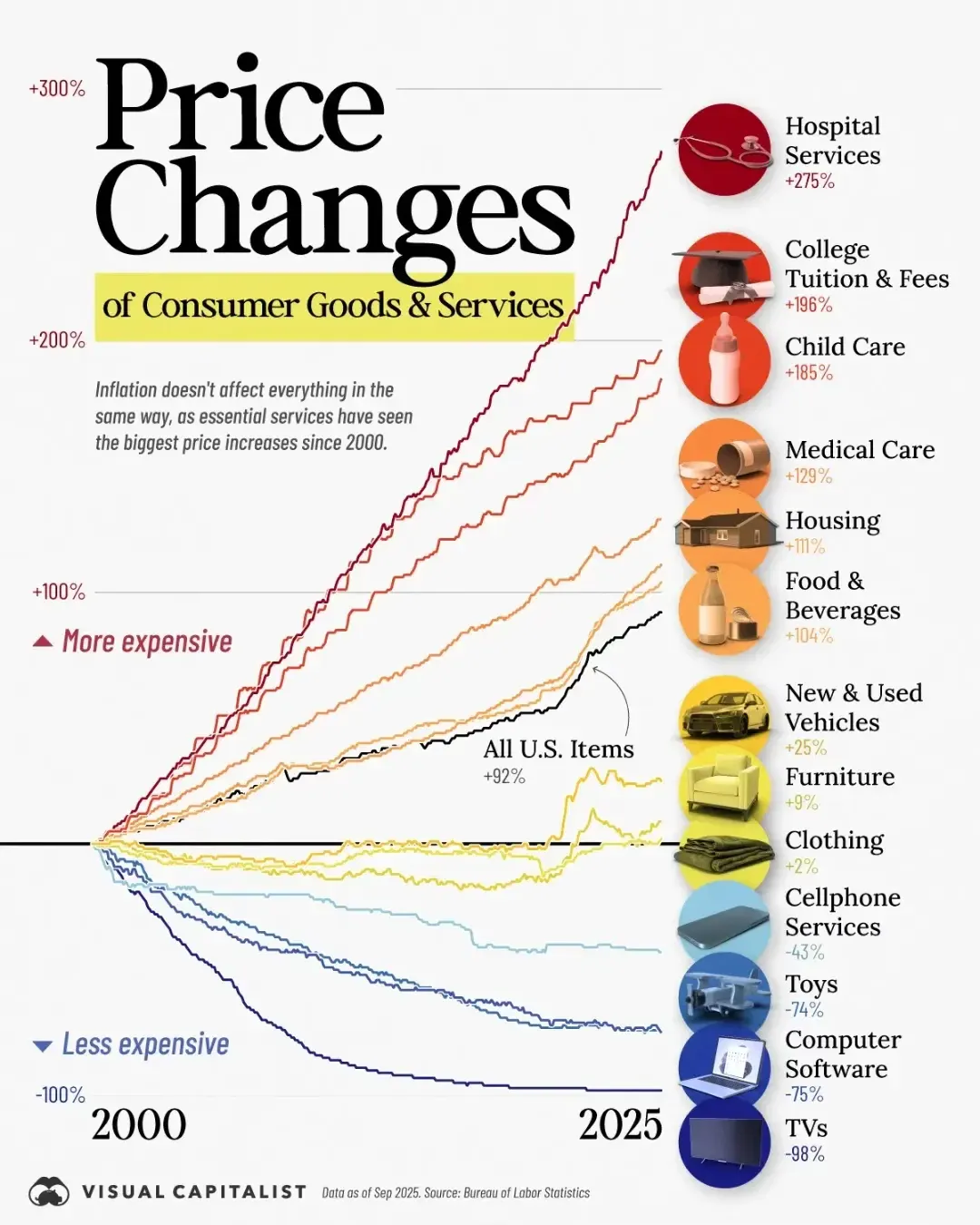
This is an excellent infographic that most people can resonate with more than the CPI headlines and inflation readings they hear or see in the news. Inflations readings now seem low, but the increase in inflation that begin in 2020 are still being felt today – especially relative to increases in income. An important learning point can be taken when observing this infographic: Market-driven capitalism pushes prices down (in inflation-adjusted terms), whereas government intervention and artificial capital reliably and consistently drive prices up (in inflation-adjusted terms).
The goods and services you see that have gone down is because those markets have (often intense) domestic and/or global competition. Sellers must continuously innovate and compete with other sellers by continually lowering their prices or increasing the quality and value provided to win over the consumers. In contrast, government-influenced sectors such as education, healthcare, medical care, and housing have seen their costs skyrocket. When governments get involved in a sector, it usually intervenes by subsidizing demand, as opposed to increasing supply or innovating.
Why is this the case? In a true free market, the value of information is critical, and that is most eloquently and efficiently displayed by market prices. Sellers must price their product or service based on what the buyer values and can afford. When the government is involved or steps in, they act as a backstop and the natural relationship between value and price is distorted. Additionally, when the government guarantees funding, it removes the natural pricing of risk vs reward for the seller. Since the capital still flows regardless of the quality or risk of the outcome, sellers lose the incentive in natural price evaluation and to operate efficiently. This usually results in prices being artificially increased and bubbles to create. This has happened time and time again and has the historical track record to be all but guaranteed.
Government involved sectors outpace inflation by 100-200% on average, while free-market sectors keep prices flat or fall over time. Research and studies, such as the CBO, Heritage Foundation, or American Enterprise Institute, show that total compensation as well as intangibles, account for roughly a 30-50% premium compared to free-market counterparts.
On a positive note – I believe that the combination of ai and humanoid robots will be massively deflationary and many sectors of our lives and that people should be hugely optimistic about the positive impact and benefits of those two emerging and innovative technologies.
The opinions voiced in this material are for general information only and are not intended to provide specific advice or recommendations for any individual. All performance referenced is historical and is no guarantee of future results.
This is an excellent infographic that most people can resonate with more than the CPI headlines and inflation readings they hear or see in the news. Inflations readings now seem low, but the increase in inflation that begin in 2020 are still being felt today – especially relative to increases in income. An important learning point can be taken when observing this infographic: Market-driven capitalism pushes prices down (in inflation-adjusted terms), whereas government intervention and artificial capital reliably and consistently drive prices up (in inflation-adjusted terms).
The goods and services you see that have gone down is because those markets have (often intense) domestic and/or global competition. Sellers must continuously innovate and compete with other sellers by continually lowering their prices or increasing the quality and value provided to win over the consumers. In contrast, government-influenced sectors such as education, healthcare, medical care, and housing have seen their costs skyrocket. When governments get involved in a sector, it usually intervenes by subsidizing demand, as opposed to increasing supply or innovating.
Why is this the case? In a true free market, the value of information is critical, and that is most eloquently and efficiently displayed by market prices. Sellers must price their product or service based on what the buyer values and can afford. When the government is involved or steps in, they act as a backstop and the natural relationship between value and price is distorted. Additionally, when the government guarantees funding, it removes the natural pricing of risk vs reward for the seller. Since the capital still flows regardless of the quality or risk of the outcome, sellers lose the incentive in natural price evaluation and to operate efficiently. This usually results in prices being artificially increased and bubbles to create. This has happened time and time again and has the historical track record to be all but guaranteed.
Government involved sectors outpace inflation by 100-200% on average, while free-market sectors keep prices flat or fall over time. Research and studies, such as the CBO, Heritage Foundation, or American Enterprise Institute, show that total compensation as well as intangibles, account for roughly a 30-50% premium compared to free-market counterparts.
On a positive note – I believe that the combination of ai and humanoid robots will be massively deflationary and many sectors of our lives and that people should be hugely optimistic about the positive impact and benefits of those two emerging and innovative technologies.
The opinions voiced in this material are for general information only and are not intended to provide specific advice or recommendations for any individual. All performance referenced is historical and is no guarantee of future results.

Securities are offered through LPL Financial, Member FINRA/SIPC. Investment advice is offered through Independent Advisor Alliance, LLC a Registered Investment Advisor. Crescendo Wealth Strategies is a DBA of Independent Advisor Alliance LLC. Independent Advisor Alliance, LLC is a separate entity from LPL Financial.
The financial professionals associated with LPL Financial may discuss and/or transact business only with residents of the states in which they are properly registered or licensed. No offers may be made or accepted from any resident of any other state.
Check the background of investment professionals associated with this site on FINRA’s BrokerCheck.
LPL Financial Form CRS
© 2025 LPL Financial
